
With the
publication of On the Origins of Species, Darwin’s theory of evolution by
natural selection has been one of the most profound theories in the biological
sciences in expounding and analysing the physical, genetic and behavioural
diversity of animals. Indeed Darwinian evolution has been a profound theory
outside of the biological sciences – namely it has had remarkable impact in the
social sciences throughout its history. During the nineteenth century, “versions
of Darwinian evolution took centre stage in political and social philosophy and
in the human sciences.” A number of anthropologists came to understand cultural
variation in terms of a linear progression to a cultural apex, then considered
Western civilisation. This interpretation was rebuked by the anthropological
school of cultural relativism and it became essentially taboo by the academy to
utilise evolutionary theory in the social sciences. That said, during the early
to mid-twentieth century a number of sociopolitical movements, such as the Nazi
party and the eugenics movement, appropriated Darwinism to justify the genocide
of certain deemed “unfavourable” and “subhuman” demographics. Such
justifications were strongly condemned by evolutionary scientists as
pseudoscientific and immoral but such utilisation of evolutionary theory in the
social sciences still remained seriously contentious. Then in 1975 the American
entomologist Wilson developed the field of sociobiology as the “systematic
study of the biological basis of all social behaviour in the context of
evolution” and in 1976 the British zoologist Dawkins developed the gene-centred
view of evolution based on “selfish genes” determining natural selection and
consequent behaviour of an organism. Whilst both Wilson and Dawkins primary aims
were with the study of non-human animals, their theories flowed over into the
realms of the social sciences. Indeed there was a profound backlash in the
social sciences academy claiming that sociobiology and the gene-centred view
were ethnocentric, reductionist, determinist and flawed in explaining human
nature. By the 1990s, the debate over human sociobiology culminated in the
development of evolutionary psychology as attempting to respond to the
criticisms against evolutionary theory in the social sciences. Led by Barkow,
Cosmides, and Tooby, evolutionary psychology aimed to understand the “neurobiology
of the human brain as a series of evolutionary adaptations and that human
behaviour and culture thus stem from the genetics and evolution of the brain.” Yet
there still exists and persists contentions from the social sciences,
particularly cultural anthropology, against sociobiology and evolutionary
psychology. This essay will examine the history of the contributions and
criticisms of evolutionary theory in the social sciences, from its racist and
pseudoscientific past to its current contributions. Then it will examine the
contributions and theory of sociobiology and evolutionary psychology as applied
to anthropology in explaining human nature and also examine the contentions and
controversy in the anthropological academy in response to such. Overall this
essay will not delve into the technical details and scientific theory of
evolutionary theory, but rather examine its claims and responses to and from in
the anthropological academy.
Darwin’s
theory of evolution by natural selection has presented an interpretation of
human nature that has been at odds with prevailing theoretical paradigms
throughout its history. The theorisation of human nature through conceptions of
evolution and instinct has been undertaken by such figures as Darwin himself, Hume,
Smith and Huxley who have proposed that the mosaic of human nature stems from innate
human instincts. Whilst this paradigm of evolutionary social science culminated
as essentially “passive and benign contemplations”, the theory of evolution of
natural selection also manifested as bigotry, racism and the apparent
justification of white Anglo male supremacy based on a linear interpretation of
history. The school of social evolutionism in the anthropological academy led
by Tylor, Morgan and Spencer became the dominant paradigm in the late ninetieth
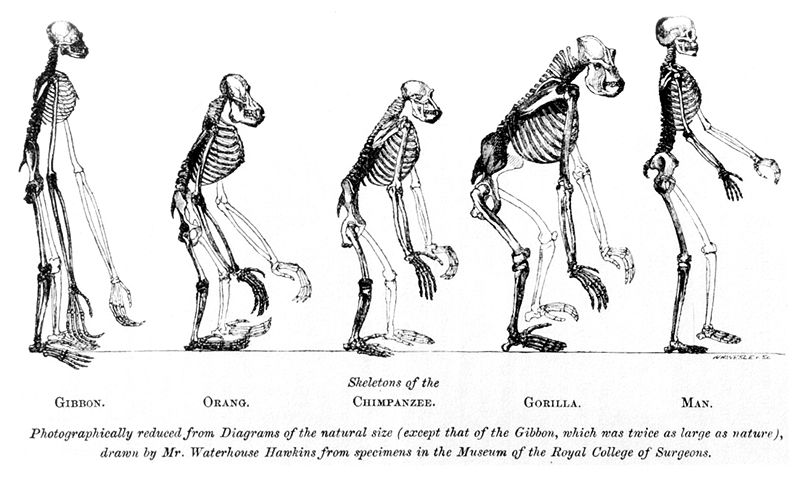
century and became appropriated as Social Darwinism in popular discourses. This
paradigm utilised the framework of evolution to describe the differences
between developed Western civilisations and non-developed “savage” cultures as stemming
from the biological inferiority of the “savages” who were considered more
related to chimpanzees than the superior Anglo-Saxons. Social movements also
took up this school of thought and supported social policies of eugenics and
forced sterilisation of certain demographics such as those in low socioeconomic
statuses, those with disabilities or mental illness, or those from non-white
ethnicities. Key responses to this school came from Boas and Kroeber in the anthropological
schools of historical particularism and cultural relativism. These schools posited
that the history of humanity is not a linear progression to the technological
civilisation of the West but rather that each culture must be understood by “its
own conditions and own particular cultural history.” Yet, there have still been
individuals and groups that support Social Darwinism, culminating in cases such
as the forced assimilation of Australian Aboriginals in the early twentieth
century and the genocide committed by the Nazi regime during 1933 to 1945.
After the Second World War, as Degler posits “the utilisation of the theory of
the biological sciences in the social sciences and the ‘biologicisation’ of
human nature became a taboo” due to the profound consequences of its
appropriations.
During the
1970s there was a revival in the theory of evolutionary theory with advances in
molecular biology, genetics, computer science and mathematical game theory. This revival was primarily aimed at explaining non-human
animal behaviour and was largely led by Wilson and Dawkins along with other
evolutionary theorists. Although this was the primary aim of the science, both
Wilson and Dawkins still theorised on the evolution of human behaviour using
the same paradigm of evolutionary theory of the study non-human behaviour. There
was profound backlash in the social sciences, primarily by Lewontin, Rose, and
Kamin and Sahlins with the scientific reductionism and biological determinism
of sociobiology in explaining culture, but also controversy surrounding the
ideological and ethical implications of such. Thus the theorists of
sociobiology then responded to such criticism and controversy with the
development of the field of evolutionary psychology. Led by Barkow, Cosmides
and Tooby, evolutionary psychology attempted to redress the claims of
reductionism and determinism by focusing on the dichotomy of nature and nurture
through holistically studying the neurobiological, cognitive and psychological
factors of human nature. Yet, the paradigm of evolutionary psychology has also too
been met with profound criticism from the anthropological academy. Despite such
criticism over legitimacy and usefulness, the fields of sociobiology,
evolutionary psychology and the general application of evolutionary theory in
the social sciences, have been increasingly taken up in the biological and social
sciences academies.

The
majority of ethical, practical and theoretical contentions in the
anthropological academy surrounding the application of evolutionary theory to
explain human nature stem from the reductionism and genetic determinism of
evolutionary theory. Indeed the question of how in the confines of the so
perceived savage, impersonal and selfish world of Darwinian natural section can
complex social structures and cultural norms come about is indeed important.
Sociobiology and evolutionary psychology as they manifest in the academic and
popular literature have been rebuked by anthropologists and other cultural
theorists as being “ethnocentric, reductionist, determinist, and
philosophically reprehensible.” Critics level evolutionary theory “is merely
academic fancy foot work away from the archaic and pseudoscientific” school of
social evolutionism of the nineteenth century, that it explicitly and implicitly
makes “false, flawed and unsubstantiated assumptions about social, political,
economic, and cultural processes”, and that even the presumption of a “human
nature itself is flawed.” Indeed as Sahlins has stated, evolutionary theory in
the social sciences is “at its worst pseudoscientific and racist and at its
best it is quasi-scientific based on flawed principles and methodology with a
profound misunderstanding of the dynamics of culture.” The responses to these
claims by evolutionary theorists have centred on pointing out the “fundamental
biological basis of humans, being an animal species just like any other” but
also pointing out the “naturalistic fallacy between making descriptive and
normative judgements."
The theory
of sociobiology and evolutionary psychology is predicated, by definition, on reducing
human behaviour to an evolutionary and biological basis. According to Lewontin and
Sahlins this does away with the cultural forces of acculturation and diffusion
and other social, economic and political dynamics. Indeed explaining human
behaviour by “reducing it down to the genes of the body and modules in the
brain” fundamentally “neglects to recognise the power of culture in shaping and
reshaping the human mind.” Thus the theorisation of the gene and or the brain
being the paramount determiner in human behaviour is flawed as it “restricts
the interpretation of behaviour and its cultural context.” Rather, Lewontin
propounds a dialectical and interactionist interpretation of human behaviour in
response to the reductionism as “it is not just that wholes are more than the
sum of their parts, it is that parts become qualitatively new by being parts of
the whole.” Lewontin propose that dialectical explanations are more effective
and holistic in explaining human behaviour in contrast to the “reductionist
calculus of the evolutionary neurobiological and gene-centred view of culture.”
In response, evolutionary theorists propose that reductionism is an “important
scientific principle.” Moreover such theorists as Barkow and Wilson propose
that the theory of evolutionary psychology also seeks a holistic interpretation
of human nature via genetic, cognitive, neurobiological and psychological
processes “based on the fact that humans have evolved to environments with
culture – that culture is not independent of evolution, but rather biology is
the precursor.” Indeed “culture is sometimes advanced as competing with
explanations that invoke evolutionary psychology, most frequently when cross-cultural
variability is observed” and these “cultural explanations invoke the notion that
differences between groups are prima facie evidence that culture is an
autonomous causal agent.” Evolutionary theorists respond to these criticisms by
stating that “cultural explanations are more or less cultural reductionism” and
“ignorant of the role of biology and innate characteristics” that have evolved
in the human species.
Along with
the claims and criticisms of reductionism against sociobiology and evolutionary
psychology is biological determinism. The critics label sociobiology and
evolutionary psychology as biological determinist and that evolutionary theory
is ignorant of the forces of nurture and the capacity of culture and social
environments to shape and reshape human nature, but also that evolutionary
theory facilitates and entrenches racism, sexism and prejudice. Indeed major
criticism against sociobiology and evolutionary psychology that stems from the
ethical, political and social implications of their theoretical underpinnings
and findings. The critics of evolutionary psychology propose that evolutionary
theory promotes or at least enables racism and sexism and does to re-entrench
out-dated perceptions of sex and race. This criticism came from key findings in
evolutionary psychology that the male and female brains evolved differently and
thus possess different cognitive and behavioural hardwiring and that certain
ethnicities are more likely to behave in certain ways or are more susceptible
to certain diseases. Indeed, some evolutionary theorists, such as Jensen have
even claimed that that intelligence is inheritable, that certain races are more
intelligent than others, and that racial economic equality is unattainable.
Thus it is proposed that just as the historically dominant class ideologies
that supported the oppression of women and ethnic minorities had strong pseudoscientific
justifications, in the form of assertions that women and ethnic minorities were
genetically inferior, sociobiology and evolutionary psychology makes it
possible again to hold such beliefs.
All this
criticism has been strongly responded to by evolutionary theorists primarily
based on pointing forth the naturalistic fallacy and that “sociobiology and evolutionary
psychology are scientific disciplines with no social agenda.” It is also put
forward that the frameworks of sociobiology and evolutionary psychology
dissolve dichotomies of nature versus nurture, innate versus learned, and
biological versus culture. It is not biological determinism but rather an
understanding that genes and other biological factors predispose certain
behavioural traits and therefore culture. Moreover, it is proposed that the
biological determinism perceived of evolutionary theory in the social sciences “as
being seen to be antithetical to social or political change is evidently
historically falsified.” Evolutionary theorists respond with that evolutionary
psychology does not privilege or prejudice individuals or groups but rather
just seeks to describe and that the claims on racial inequality being
inevitable by Jensen and Herrnstein have been discredited in the evolutionary
theory by fellow theorists such as De Waal and Pinker. Indeed, it has been
asserted that critics have been putting forth critiques based on personal
political and ethical values rather than any empirical or explanatory factors
and thus the attacks against evolutionary theory have been made on “non-scientific
grounds”. Sociobiologists and evolutionary psychologists “should and do
acknowledge the role of ideology and politics in the formation and support of
scientific paradigms” but do not let it influence their own paradigm. Moreover
it is noted that “genetically determined mechanisms do not imply genetically
determined behaviour” and thus the theory of sociobiology and evolutionary
psychology is not predicated on genetic determinism. Fundamentally critics do
not recognise the naturalistic fallacy in their critiques of the ethical
implications of evolutionary theory. Indeed “an explanation is not a
justification” and neither sociobiology nor evolutionary psychology attempt to
justify the existence of social hierarchies, racism or sexism – “when they are
and have been used to justify such than evidently that is not scientific.” It
is posited that any “politically incorrect assertions of evolutionary psychology
are based on considerable empirical evidence” and indeed critics are welcome to
challenge the evidence or provide testable alternative explanations. Overall it
is a profound misunderstanding of sociobiology and evolutionary psychology to
claim it is biological determinist when it takes in genetic, neurobiological,
and cultural evolution of human behaviour. Thus when the theoretical paradigm
fails to achieve such a spread of looking at genetic, neurobiological and
cultural factors, theorists agree with critics that such a paradigm is indeed
flawed.
The
resurgence of evolutionary theory in the social sciences has indeed been a
contentious and controversial one with much criticism being levelled against it
but it also has managed to make constructive contributions to the
anthropological academy. With its archaic and pseudoscientific beginnings in
the schools of social evolutionism and Social Darwinism of Tylor, Morgan and
Spencer arguably behind it, Wilson and Dawkins and then Barkow, Cosmides and
Tooby and others transformed the application of evolutionary theory in the
social sciences. Yet indeed the theory of sociobiology and evolutionary theory
was met with critical claims of ethnocentrism, determinism and reductionism by Sahlins,
and Lewontin, Rose, and Kamin and others, it responded with arguments stemming
from the naturalistic fallacy and that it is a misunderstanding of the theory
to label it determinist. Indeed the majority of theorists, both evolutionary
and non-evolutionary, acknowledge that it is flawed and invalid to make purely
reductionistic and biologically determinist explanations for human nature,
specifically culture. Thus evolutionary theory attempts to employ a holistic
interpretation based on neurobiological, genetic and cultural factors whilst
firmly grounded in the understanding that humans have evolved with culture. Overall,
whilst evolutionary theory in the social sciences, particularly cultural
anthropology, has been and still largely is contentious, it is becoming the
popular and prevailing paradigm once again. Thus sociobiology and evolutionary
psychology must not revert to their natal beginnings in the application of the
human sciences through justifying racism and sexism and other forms of violence
and prejudice of the times of Social Darwinism. Fundamentally evolutionary
theory must progress cautiously in explaining the politically, socially and
morally sensitive issues that exist. Indeed making politically incorrect
findings through evolutionary theory is essentially inevitable and should not
be refrained from, but its theorist must recognise the consequences as they
manifest in the social environment that it exists in.
Tasman Bain is a second year Bachelor of Arts (Anthropology) and Bachelor of Social Science (International Development) Student at the University of Queensland. He is interested evolutionary anthropology, social epidemiology and philosophy of science and enjoys endurance running, reading Douglas Adams, and playing the glockenspiel.
